Flexible Logging Modes · Built for Different Study Durations
|
 |
• High-Frequency Logging
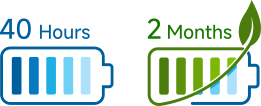
1 Hz continuous logging: approx. 40 hours
Ideal for short-term studies requiring continuous, detailed movement
tracking.
|
|
|
 |
• Interval Logging
Every 2 minutes: approx. 1 month
Every 10 minutes: approx. 2 months
Ideal for medium- to long-term animal tracking where both track continuity
and battery life are important. |
|
|
 |
• Scheduled Logging
Scheduled daily logging: approx. 3–6 months
Ideal for long-term field monitoring and studies of seasonal animal activity
patterns. |
|
|
|
| Battery life estimates are based on testing under open-sky conditions with good satellite reception. Indoor use or other environments with weak GNSS signals may significantly reduce battery life. Actual battery life in Scheduled Logging mode depends on daily logging duration and other configuration settings. |
|
Compact Size · Precision Without Compromise |
To achieve its ultra-compact form factor, the V-2000 uses a specially
designed miniature GNSS antenna. Smaller antennas present greater
engineering challenges, requiring careful RF design to maintain antenna
performance and positioning accuracy within a very limited space.
Through extensive optimization and testing, the V-2000 delivers positioning
accuracy comparable to larger GNSS receivers while maintaining its
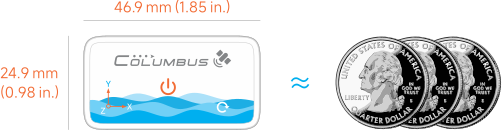
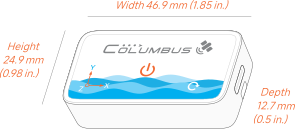
ultra-compact design. Within a body just 0.98 in (24.9 mm) wide, it
integrates the GNSS antenna and receiver, motion sensor, power system, and
data storage.
Small size, no compromise.
The V-2000 combines compact dimensions with reliable positioning performance
and full-featured data logging.
|
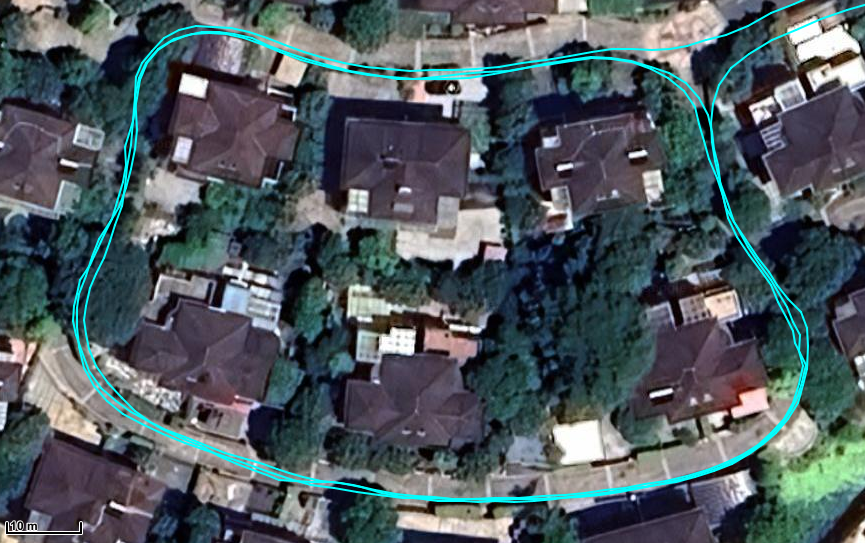
Test: Three consecutive laps along the same
route to evaluate track smoothness and repeatability at low speeds.
Test Date: UTC 2026-09-10 17:16:34 ~ 17:22:06 | Average Speed: 9.6 km/h
Device Placement: Below the vehicle windshield, with the receiver
facing upward.
Environment: Dense buildings and trees nearby.
Download Track Data > |
|
Step 1: Download the track |
Step 2: Play back the track using TimeAlbum Pro |
|
|
 |
|
GNSS + 3-Axis Acceleration · From Tracking to Motion Analysis |
The V-2000 records not only where a subject moves, but also how it moves.
Its built-in 3-axis accelerometer records X, Y, and Z acceleration data
alongside GNSS tracks. By combining location and motion data, researchers
can analyze movement states such as resting, walking, running, flying, and
other behaviors, as well as activity levels, behavioral transitions, and
daily activity patterns—providing richer data for animal tracking and
behavioral research.*
* Specific behaviors must be identified and classified through further
analysis of the collected data using tools such as MATLAB or R.
|
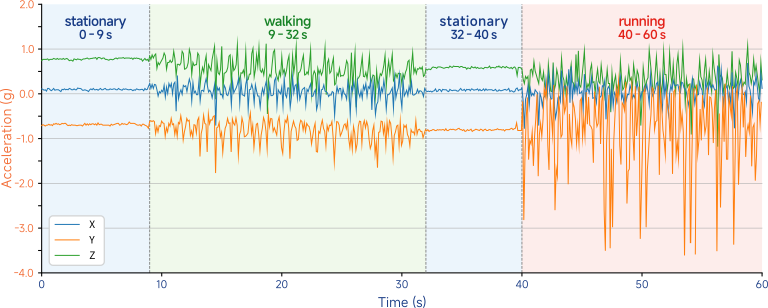
Motion Analysis Using V-2000 3-Axis
Acceleration Data
The V-2000 was attached to the tester’s waist, with 3-axis
acceleration sampled at 10 Hz.
The chart clearly shows distinct acceleration patterns as the tester
transitions from stationary → walking → stationary → running,
demonstrating how different movement states produce different
acceleration signatures. |
|
|
 |
|
Flexible Data Formats |
The V-2000 supports Columbus’ standard CSV track format,
allowing existing users to migrate easily from products
such as the P-1 Mark II and P-10 Pro without changing
their existing data workflows.
In addition to CSV,
GPX, and NMEA, the V-2000 introduces FUSION, a new
high-efficiency data format developed by Columbus
specifically for the V-2000. Compared with standard CSV,
FUSION uses approximately 20% less storage while
combining 3-axis acceleration (ax / ay / az) and GNSS
data in a single record, providing greater storage
efficiency and richer datasets. |
| |
|
Data Capacity |
Data Fields |
Compatibility |
|
| |
FUSION |
Highest |
Most |
Moderate |
|
| |
|
| |
CSV |
High |
Many |
High |
|
| |
|
| |
GPX |
Moderate |
Moderate |
Widest |
|
| |
|
| |
NMEA |
Moderate |
Many |
High |
|
| |
|
|
| |
|
USB-C Direct Access · Fast, Efficient Data Retrieval |
|
 |
|
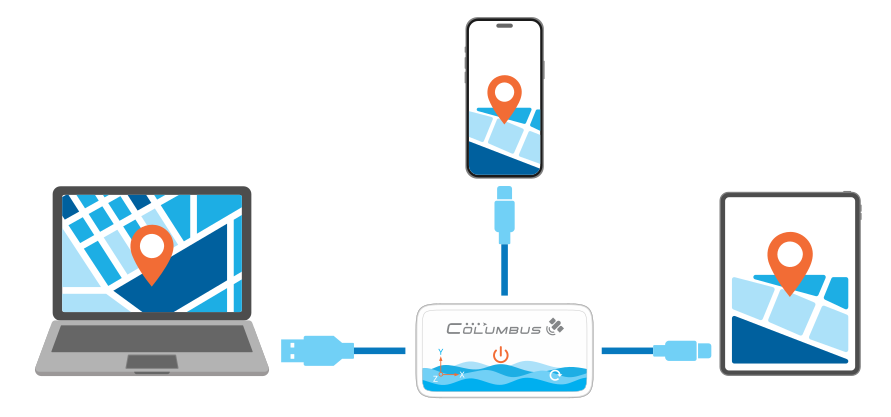
The V-2000 uses standard USB Mass Storage, allowing
direct access to track files on Windows, macOS, Linux,
and Android—no dedicated desktop software required.
A track file can be accessed in approximately 5
seconds*, significantly improving data retrieval
efficiency compared with conventional proprietary
transfer methods.
USB OTG is also supported, allowing track files to be
accessed directly from compatible smartphones and
tablets.
For research projects deploying dozens or even hundreds
of devices, fast and direct data access can
significantly reduce the time required for device
management and data collection.
* Based on a file containing 10,000 track points. |
|
Flexible Configuration · Configure It for Your Research |
|
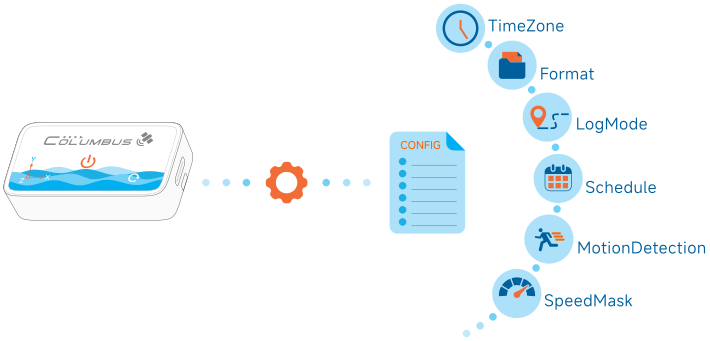 |
The V-2000 requires no dedicated configuration
software. Settings can be easily edited with a
standard text editor, making it simple to configure
and deploy large numbers of devices for research
projects.
A wide range of settings can be customized through
the configuration file, including:
• Time Zone
•
Motion Detection: Multiple sensitivity levels
• Logging Format: FUSION / CSV / GPX / NMEA
• Data Type: GNSS / GNSS + IMU / IMU
• Logging Interval: Time- and distance-based logging
modes
• Speed Mask
• Scheduled Wake-Up and Logging Duration |
|
|